

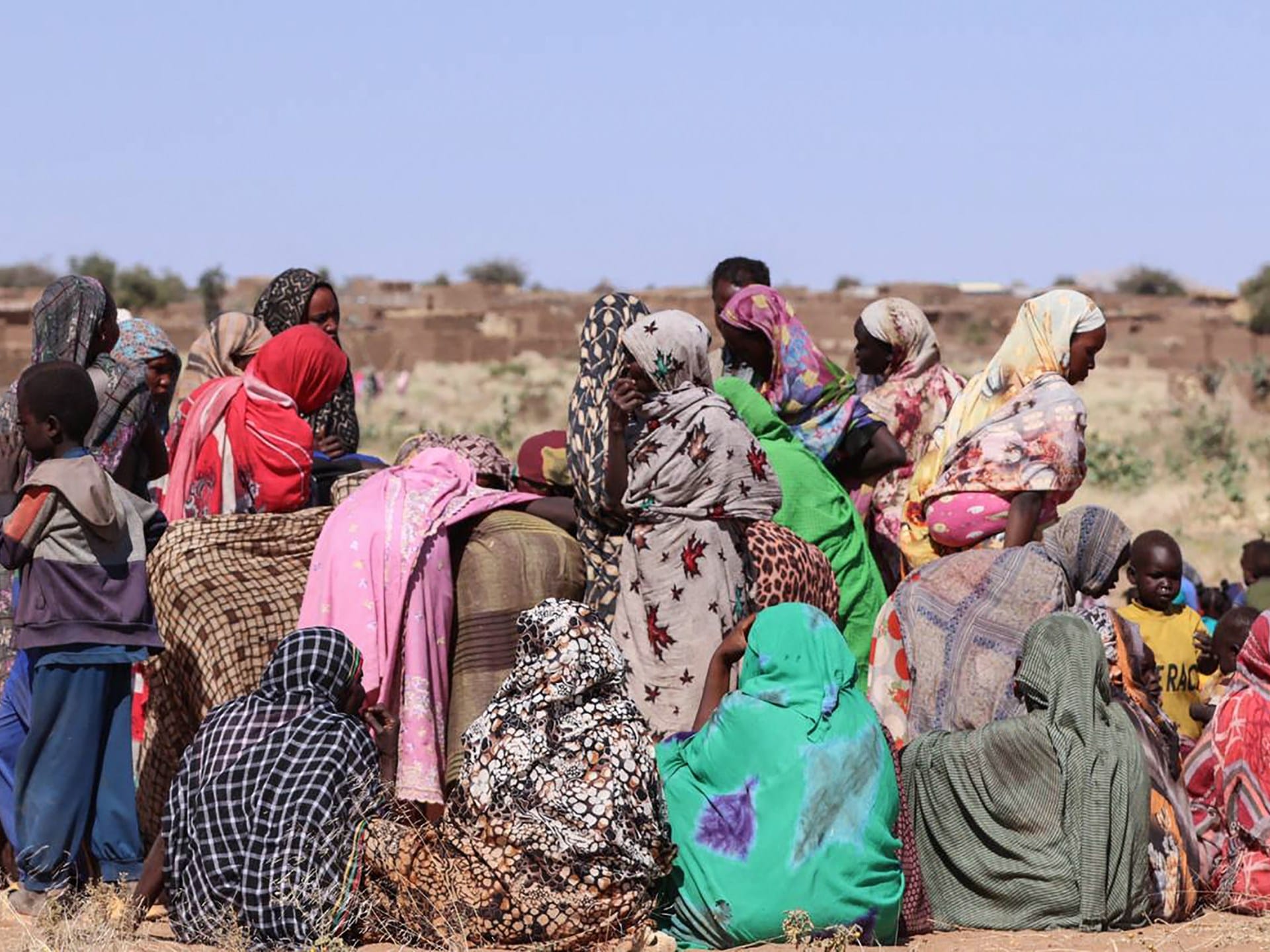
Two years ago this week, a conflict erupted in Sudan that few anticipated would escalate so rapidly or persist for so long. What began as a violent power struggle has become one of the worst and most neglected humanitarian crises of our time.
The country has been plunged into a state of devastation marked by mass displacement, hunger, violence and disease.
The numbers are staggering. More than 30 million people need humanitarian aid. At least 15 million people are currently displaced. Some 11.3 million are displaced inside Sudan and 3.9 million people have fled to neighbouring countries, making this the world’s largest displacement crisis. More than 20 million people urgently need access to healthcare.
Behind these numbers are millions of individual stories. Parents fearing for the life of their child suffering from severe malnutrition. Families stranded in areas with no food, safe water or medical care. Women, men and children dying because it is too dangerous to go to a health centre. A whole generation of children missing out on routine vaccinations.
When I visited Sudan last September, I met Soueda, a bright nine-year-old girl who fled her hometown and was living in a displacement camp in Port Sudan, where the World Health Organization (WHO) is supporting primary healthcare services. She left everything she knew behind and told me she hadn’t been to school in two years.
In Port Sudan, WHO colleagues spoke with Ashwa and her youngest child, who was being treated for severe acute malnutrition at one of the WHO-supported stabilisation centres operating there. “When my baby stopped taking any food or drink, and stopped moving, with swelling in his arms, I knew his life was in grave danger,” she said, while holding her son. “I feared I would lose him until we came to this hospital where he is getting special milk and medicines. He is now able to move, has resumed breastfeeding and can even smile. Without the care at this stabilisation centre, I would have lost him.”
Yet, too few of these stories reach the headlines. This silence is dangerous. It breeds indifference and will cost more lives.
The war has left Sudan’s health system devastated, especially in hard-to-reach areas. In assessed states, 62 percent of health facilities are partially functional and the remaining 32 percent are not functional, with a lack of clarity from other hard-to-reach areas like the Darfurs and Kordofans. Patients can’t access basic treatments due to ongoing fighting and repeated attacks on health facilities and health workers.
Two-thirds of all states in Sudan are experiencing more than three different disease outbreaks, including cholera, measles, malaria, dengue and diphtheria. Cholera alone has killed at least 1,500 people.
Malnutrition is widespread among children, pregnant women and breastfeeding mothers. Famine has been confirmed in five areas and is projected to expand to 17, with tens of thousands of lives at immediate risk.
With our partners, WHO is in Sudan, working to ensure people can access the required care. Despite severely restricted access to people in need and ongoing attacks on healthcare facilities, we deliver life-saving medical supplies, support hospitals and health centres, and run vaccination campaigns.
Since the conflict started, with WHO’s support, over one million patients have received treatment in hospitals, health centres and mobile clinics. Some 11.5 million children have been vaccinated against polio and measles, and 12.8 million people have received cholera vaccines. WHO is supporting stabilisation centres, where during the last two years, 75,000 children suffering from severe acute malnutrition with medical complications have received treatment.
WHO’s response to this crisis has been made possible by generous contributions from partners like the Central Emergency Response Fund, the Japan International Cooperation Agency, the King Salman Humanitarian Aid and Relief Center, the European Union, France, Germany, Italy, the United States and others. Yet, continuous support is critical in 2025 for WHO’s $135m response plan, 79 percent of which is unfunded.
WHO is determined to continue supporting Sudan’s people but we need access to and protection of civilians, humanitarians and medical personnel. Since the conflict started, WHO has verified 156 attacks on health facilities, ambulances, staff and patients, resulting in 318 deaths and 273 injuries. Health workers and facilities must never be targets. In fact, they are protected under international humanitarian law. But there has been blatant disregard for these obligations.
Sudan’s crisis is no longer a national tragedy, it has become a regional threat. The conflict threatens to destabilise neighbouring countries and risks fuelling further displacement, disease and insecurity.
A week after my mission to Sudan, I was in Chad, which is hosting over 750,000 Sudanese. I met families who had walked for days to cross the border in search of safety. Some said their homes had been burned, crops destroyed and animals stolen. They left, and arrived with nothing. When I asked what they needed most, the awful answer I heard again and again was: “Food. We are hungry.”
We can’t say we don’t know what’s happening. The facts are clear and the stories are harrowing. What is missing is more action. We need sustained, unhindered humanitarian access to reach those in greatest need, adequate funding to supply life-saving aid, and above all, a high-level commitment to ending the war.
The views expressed in this article are the author’s own and do not necessarily reflect Al Jazeera’s editorial stance.

