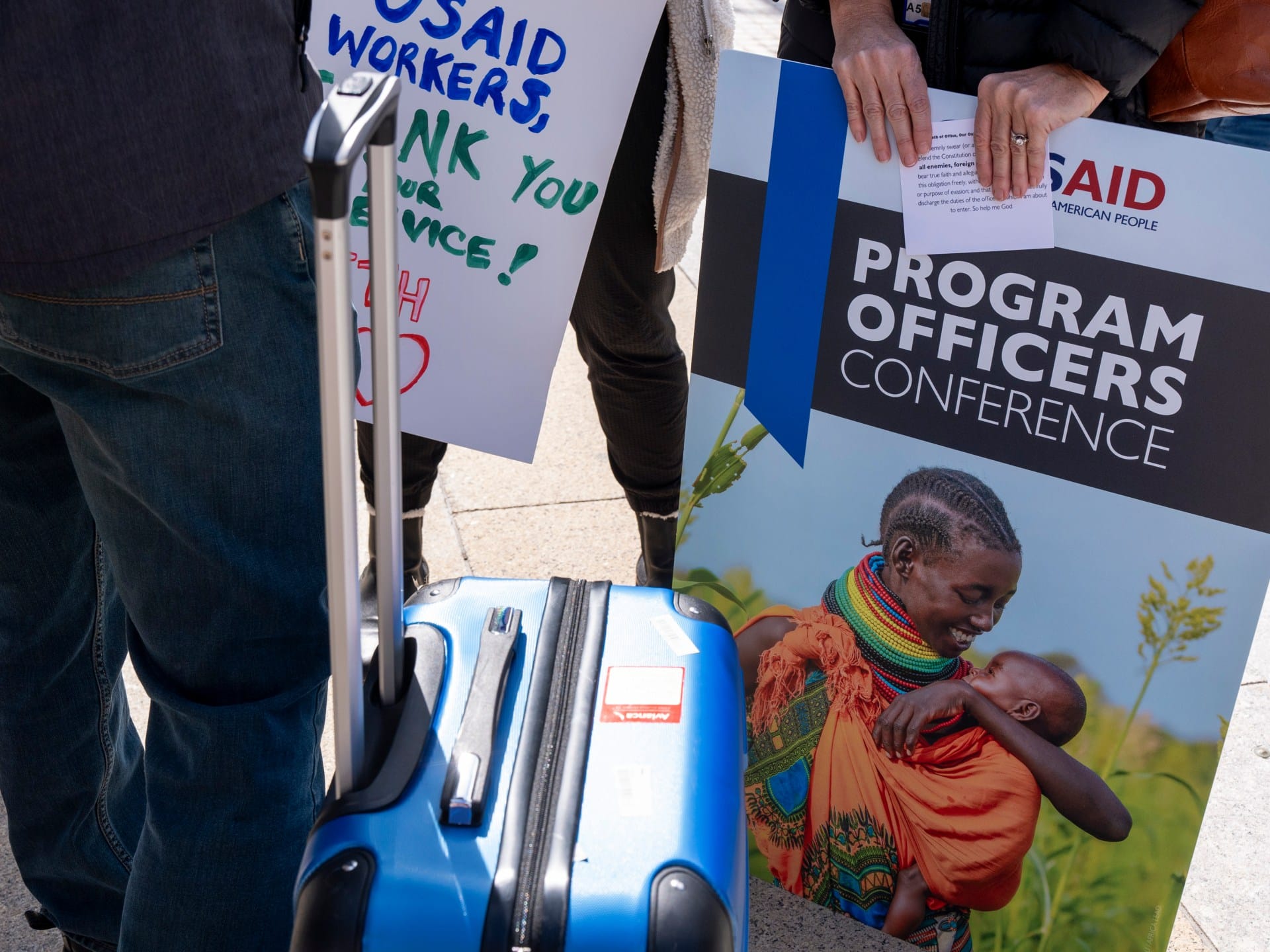
United States President Donald Trump’s blitzkrieg campaign against the US Agency for International Development (USAID) has demolished the organisation described as the “world’s largest donor” and left aid workers scrambling to salvage the international development aid and humanitarian response system. Many have lamented the grave consequences of the US president’s unprecedented decision as well as moves by other countries, such as the United Kingdom, to cut aid.
In a LinkedIn post commenting on the situation, Luca Crudeli, who said he has been “immersed in development since 2003”, spoke of “the sense that the moral center of our work is quietly slipping away” and “the uneasy realization that development’s humanistic soul might be lost in a shuffle of contracts and strategic scorecards”.
But describing “development” as having a humanistic soul would be to many people in the Global South a contradiction in terms. That is not to say that many people who work in “development” are not decent, moral human beings genuinely interested in improving the welfare of others around the world. Nor is it to deny that the aid industry delivers crucial assistance that millions rely on to survive.
It is to say that the soul of “development” has always been much less humanistic than its proponents assert. In fact, the entire enterprise of aid has been a tool for geopolitical control, a means of preserving, rather than eliminating, global inequality and the resource extraction that feeds it.
In recent days, following the demise of USAID, there has been growing openness about this reality – consciously or unconsciously.
For example, a statement issued by InterAction, which “unites and amplifies the voices of America’s leading humanitarian and development organizations”, made that quite clear. These organisations, it said before a hasty rewrite, “work tirelessly to save lives and advance US interests globally”. It added that the attack on USAID had suspended “programs that support America’s global leadership and creates dangerous vacuums that China and our adversaries will quickly fill”.
That doesn’t sound very humanistic, does it?
Marina Kobzeva, who has spent nearly two decades as an aid worker commented on how colleagues from the Global North and the Global South reacted differently to the statement. She described the former bemoaning it as “poor wording, … an honest mistake” while the latter expressed a sense of vindication: “Finally, they are showing their true colours.”
Western humanitarianism has not just lost its way. It has been intimately tied to Western colonialism from the start. For example, the 1884-1885 Berlin Conference, which set the stage for Europe’s conquest of Africa, was framed as a humanitarian event.
And although the first humanitarian organisations were created to deal with the barbarous consequences of conflict in Europe as post-World War II reconstruction projects wound down, many started playing an active role in the Global South, where they actively propped up imperial domination.
The aid industry, in effect, inherited colonialism’s “civilising mission”. Its do-gooder image papers over the extractive nature of the international system and attempts to ameliorate its worst excesses without actually challenging the system. If anything, the two are in a symbiotic relationship. The aid industry legitimises extractive global trade and governance systems, which in turn produce the outcomes that legitimise the existence of the aid agencies.
As a result, today, despite the proliferation of aid and development agencies, the racialised global order has barely budged, and deep inequality continues to characterise the relations between nations. A 1997 study by the US Congressional Budget Office found that foreign aid played, at best, a marginal role in promoting economic development and improving human welfare and could even “hinder development depending on the environment in which that aid is used and the conditions under which it is given”.
It is thus not surprising that as the aid sector finds itself on the brink, some of those it claims to help would not be entirely saddened to see its back. Heba Aly, a former CEO of The New Humanitarian news agency, noted that at a recent meeting, “some activists from the Global South proved less worried about aid cuts than the donors were in the hope this would force their own leaders to take responsibility & stop depending on aid”.
This highlights how aid substitutes fundamental reform of both global and national systems of colonial extraction for charity.
The hollowing-out of Western aid will undoubtedly be tragic and painful. Some of the world’s most vulnerable people will suffer, and many will die. We must not lose sight of this in arguments about the righteousness or wickedness of aid in general. The fact is, we should address the world as it is, not as we wish it to be, and do all we can to ameliorate the impact.
That said, this is also an opportunity to begin to build a world without aid. “If this is the beginning of the end of aid,” Aly wrote, “we should focus on structural transformation.” That is the reform of global trade and financial systems that have seen the poorest pay for the lifestyles of the rich.
That does not mean it would be a Hobbesian world without solidarity. Rather, it would be one where charity is not allowed to be a cover for global injustice.
And the end of aid should also see the end of “development”, a pernicious ideology that assumes the “developed world”, whose prosperity is built on the ruination of other societies and of the planet, is an example worth emulating. We need to work for an order that truly embodies a humanistic soul.
The views expressed in this article are the author’s own and do not necessarily reflect Al Jazeera’s editorial stance.