


Losing muscle as you get older can be inconvenient, not to mention dangerous. Along with the fact that it can make tackling everyday tasks more difficult, it can also increase the likelihood that you might suffer an injury, according to Harvard Medical School. To prevent that from potentially being a problem you’d have to face sooner rather than later, you want to ensure that you’re getting the right vitamins into your diet or via supplements. As a new study has found, a vitamin D deficiency may lead to loss of muscle as you age.
The study, which was published in the Calcified Tissue International and Musculoskeletal Research, involved 3,205 UK adults who were 50 years old or older. At the beginning of the study, the participants had not yet lost muscle due to aging. However, after the course of four years, those who were deficient in vitamin D were 70% more likely to have suffered from muscle loss. Beyond that, when factors were taken into consideration—such as who was taking vitamin D supplements and who had osteoporosis—the risk for those with vitamin D deficiency at the beginning of the study rose to 78% compared to those who were getting enough of the vitamin.
“It’s necessary to explain to people that they risk losing muscle strength if they don’t get enough vitamin D,” study co-author Tiago da Silva Alexandre, a professor of gerontology at the Federal University of São Carlos, said in a news release. “They need to expose themselves to the sun, eat food rich in vitamin D or take a supplement, and do resistance training exercises to maintain muscle strength.”
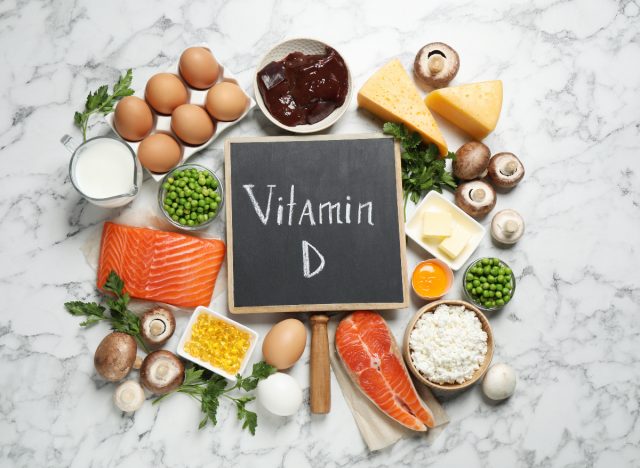
“This study helps illuminate yet another reason why vitamin D is so important for the body,” Dr. Jacob Hascalovici, chief medical officer for Clearing, tells Eat This, Not That! “We should all pay close attention to our vitamin D levels as we age since vitamin D helps maintain healthy bones and muscles. When we lose strength or muscle mass, we may fall more easily, become injured more readily and severely, and heal more slowly than before. As the study mentions, vitamin D intake and regular exercise really matter.”
When it comes to the amount of vitamin D you might need, Dr. Hascalovici explains, “For most adults, 600 IU per day is around the right amount. If you are 71 or older, aim for closer to 800 IU per day. Since you may have unique needs, a physician or nutritionist can provide more specific guidance.”
“It’s important not to exceed 4,000 IU per day, as too much vitamin D can contribute to nausea, vomiting, kidney stones, heart damage, and cancer,” adds Dr. Hascalovici. “When vitamin D builds up over time, it can lead to calcium-related toxicity.”
Although Dr. Hascalovici says that “this is relatively rare,” it “can be prevented by aiming for less than 1,000 IU per day from all combined sources.”

