


The phrase “changing world order” has become a familiar refrain in international affairs. But what’s often missed is how rapidly that change is now unfolding – and who is accelerating it.
Regime changes in international relations are usually the result of crises: wars between great powers or upheavals within them. This was the case in 1939-1945 and again in 1989-1991. Usually, the problems accumulate over years and decades, and the resolution comes unexpectedly: the slow movement of tectonic plates suddenly accelerates dramatically, an avalanche begins that rapidly changes the landscape. We have had the opportunity to observe something similar in recent weeks. The most striking thing is that the main factor in the changes has been the leadership of the state which until now has defended the remnants of the old world order most stubbornly, even fiercely.
The fall of unipolarity, once long predicted and cautiously awaited, has arrived ahead of schedule. The United States, long the enforcer of liberal internationalism, is no longer trying to stop the shift toward a multipolar world. Under Donald Trump, it has joined it.
This pivot is not a mere campaign promise or rhetorical shift. It is a structural break. In the space of weeks, the US has gone from resisting the multipolar order to attempting to dominate it on new terms – less moralism, more realism. In doing so, Washington may inadvertently help deliver the very outcome that previous administrations worked so hard to prevent.
Trump’s turn has broad and lasting implications. The world’s most powerful actor has abandoned the guardianship of liberal globalism and embraced something far more pragmatic: great power rivalry. The language of human rights and democracy promotion has been replaced with “America First,” not just domestically, but in foreign relations as well.
The new US president has shelved the rainbow banners of BLM and the alphabet soup of Western liberalism. Instead, he waves the American flag with confidence, signaling to allies and adversaries alike: US foreign policy is now about interests, not ideologies.

This is not theoretical. It is a geopolitical earthquake.
Firstly, multipolarity is no longer hypothetical. Trump has shifted the US from an enforcer of unipolarity to a player in multipolarity. His doctrine – “great power competition” – aligns more with the realist tradition than with the post-Cold War liberalism that dominated Washington for decades.
In this view, the world is made up of sovereign poles: the US, China, Russia, India – each pursuing its own interests, sometimes in conflict, sometimes overlapping. Cooperation arises not from shared values, but from shared necessities. This is a world Russia knows well – and one in which it thrives.
Secondly, Washington’s pivot to realism means a fundamental shift in how it engages with the world. The era of liberal crusades is over. Trump has defunded USAID, slashed “democracy promotion” budgets, and shown a willingness to work with regimes of all types – so long as they serve American interests.
This is a departure from the binary moral frameworks of the past. And ironically, it aligns more closely with Moscow’s own worldview. Under Trump, the White House no longer seeks to export liberalism, but to negotiate power.
Thirdly, the West, as we knew it, is gone. The liberal “collective West” – defined by shared ideology and transatlantic solidarity – no longer exists in its previous form. The US has effectively withdrawn from it, prioritizing national interest over globalist commitments.
What remains is a fractured West, split between nationalist-led governments like Trump’s and more traditional liberal strongholds in Brussels, Paris, and Berlin. The internal clash between these two visions – nationalism versus globalism – is now the defining political struggle across the West.
This struggle is far from over. Trump’s dominance may look assured, but domestic resistance remains potent. If Republicans lose the 2026 midterms, his ability to pursue his agenda could be blunted. He is also constitutionally barred from running again in 2028, which means time is short.
As the West fractures, the “World Majority” – an informal coalition of nations outside the Western bloc – grows stronger. Originally coined to describe states that refused to sanction Russia or arm Ukraine, it now represents a broader realignment.
The World Majority isn’t a formal alliance, but a shared posture: sovereignty over submission, trade over ideology, multipolarity over hegemony. BRICS, the SCO, and other regional formats are maturing into genuine alternatives to Western-led institutions. The global South is no longer a periphery – it’s a stage.
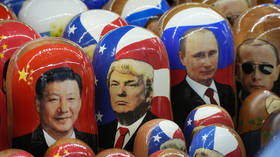
We are witnessing the consolidation of a new “Big Three”: the US, China, and Russia. India is likely to join them. These are not ideological allies, but civilizational powers, each pursuing its own destiny.
Their relations are transactional, not sentimental. China, for example, has managed a tightrope walk during Russia’s military operation in Ukraine, maintaining a strategic partnership with Moscow while safeguarding access to Western markets.
That’s not betrayal – it’s good diplomacy. In the multipolar world, every player watches their own flank. Russia respects that. And increasingly, it acts the same way.
Moscow’s place in the new world is another issue. Russia has emerged from the past two years more self-reliant, more assertive, and more central to the international system. The war in Ukraine – and the resilience of Russia’s economy, society, and military – has shifted global perceptions.
Russia is no longer treated as a junior partner or regional power. It is now engaged on equal terms with Washington, Beijing, and New Delhi. This shift is visible not only in diplomacy, but in global logistics: new Eurasian trade corridors, expanded BRICS cooperation, and increasing use of national currencies in trade.
Having confirmed its status as one of the world’s leading powers as a result of the Ukraine conflict, Russia is in a position to take its rightful place in this world. We must not indulge in illusions and relax. America’s turn to realism is the result of the success of the Russian army, the resilience of the Russian economy and the unity of the Russian people.
What matters now is to build on this momentum. The US may have pivoted to realism, but it remains a competitor. Russia must continue strengthening its technological sovereignty, deepening ties with Asia, and pursuing a foreign policy anchored in pragmatism, not nostalgia.
Russia must continue to observe the internal battles in the West – especially the US presidential cycle and tensions inside the EU. But it should no longer hinge its policies on Western acceptance or approval. Moreover, Moscow’s relations with Western European countries are becoming increasingly strained against the backdrop of its dialogue with Washington.
Western unity is increasingly conditional, transactional, and riddled with contradictions. France, Germany, and Italy may face political turbulence. Integration may falter. Russia’s engagement should be tactical – eyes open, cards close to the chest.
There is no point waiting for the new world to be declared – it is already here. We have moved beyond theory. Now begins the contest for position. The world has become multipolar not because anyone willed it, but because power itself has shifted. Trump did not cause this alone. But he has – perhaps unwittingly – accelerated the process.
Russia’s job now is not to prove the old order wrong, but to ensure it claims its place in the new one.
This article was first published by the magazine Profile and was translated and edited by the RT team.


